Showing posts with label Preservation Week. Show all posts

Tuesday, April 19, 2016

Preservation Week Webinars

Preservation Week is an annual celebration hosted by the American Libraries Association, Association for Library Collections & Technical Services, Preservation and Reformatting Section. This year there are two free webinars that may be of interest to the public as well as preservation professionals:

From Cassette to Cloud: Reformatting Audiotape
Tuesday, April 26, 2016
Webinar begins at 2pm Eastern, 1 pm Central, noon Mountain, and 11 am Pacific
Krista White, Digital Humanities Librarian, Rutgers University-Newark
Oral histories can provide a wealth of information about individual and community life. This
webinar explores ways these recordings can be digitized, and the challenges in doing so.

For additional information and access to the free registration links, please go to the following website: http://www.ala.org/alcts/confevents/upcoming/webinar/042616

Preserving Your Digital Life
Thursday, April 28, 2016
Webinar begins at 2pm Eastern, 1 pm Central, noon Mountain, and 11 am Pacific
Krista White, Digital Humanities Librarian, Rutgers University-Newark
Many of us record and keep personal and family stories in digital formats. This webinar explores steps to take now to for preserving these narratives for future generations. means considering how we create the files and how we store them. What steps can we take now to make the ensure the best possibility of retaining these important files into the future?

For additional information and access to free registration links, please go to the following website: http://www.ala.org/alcts/confevents/upcoming/webinar/042816

These webinars are primarily intended or individuals, but will also be of interest to local historical societies and other cultural heritage groups.

ALCTS webinars are recorded and registrants receive a link to the recording shortly following the live event.

Thanks to ALCTS Continuing Education Committee for providing this information.

For more information about Preservation Week go to: http://www.ala.org/alcts/preservationweek

Tuesday, July 21, 2015

The ABCs of Digital Preservation

April 27 through May 1 of this year marked the American Library Association's 5th Annual Preservation Week. To celebrate, I gave a talk for library staff titled The ABC's of Digital Preservation. The purpose of the talk was to introduce some basic digital preservation concepts, such as choosing file formats, file naming best practices, and the basics of preservation metadata. I also discussed some tools and models for managing digital materials, and tried to demystify some of the acronyms I throw around casually in meetings ("If we follow OAIS, the SIP could contain a TIF and some PREMIS and or METS, and of course the AIP will need an md5...").  You can view the slides of the talk here. 

The talk was well attended, and I got a lot of good feedback and follow-up questions. In this blog post, I'd like to address these questions, and talk about some resources to learn more about topics discussed in my presentation.

First, I'll start with some general resources...

In creating and organizing my presentation, I was inspired by the North Carolina Department of Cultural Resource's Digital Preservation Best Practices and Guidelines. It's a great resource and an excellent starting point.

Read through the archives and follow The Signal, the digital preservation blog of the Library of Congress. They highlight a lot of amazing projects covering all aspects of digital preservation.

Also, the North East Document Conservation Center has some great resources.

Now, on to your questions...

1. Is there a list of file formats defining their function that I could reference?

Yes! The Library of Congress developed this great resource for file format descriptions. The South Carolina Department of Archives and History also has a nice resource on File Formats.

2. Could you point me toward a bibliography of good guides for organizing photographs (or perhaps a workshop)?

Library of Congress's Personal Digital Archiving project has a good, succinct guide to archiving digital photos. Here's another great resource created by MLIS students at Catholic University of America for Preservation Week. Mike Ashenfelder also wrote a great blog post on The Signal answering questions about digital photo archiving (you should check out the webinar he references as well!) And finally, here is an amazing resource for digging into embedding metadata in digital images.

3. Can you tell me more about the Digital POWRR Tool Grid?

"The POWRR Tool Grid v2 provides a set of interactive views designed to help practitioners identify and select tools that they need to solve digital preservation challenges. This Grid is based on the Tool Grid first developed by the Digital POWRR Project, and combines the form and function of the original POWRR grid with the far greater coverage of tools provided by the COPTR data feed."

4. What are the current archival standard for image scans- resolution and bit depth?

The Federal Agencies Digitization Guidelines Initiative (FADGI!) has an excellent document that goes into great detail providing best practices for image scans:  Technical Guidelines for Digitizing Cultural Heritage Materials .  ALTCS, a division of ALA, has also published a helpful guide for Minimum Digitization Capture Recommendations for many types of media.

5. What are the best practices for preserving video files (ideal formats, codecs, etc.)?

Choosing a file format and codec for video preservation master files is complex. A lot depends on available resources, technological expertise, and the context in which files are created and managed. FADGI has done an excellent analysis of the issues involved in their report Digital File Formats for Digital Tape Reformatting. For best practice guidelines for creation and management of digital video, I really love the Activist's Guide to Archiving Video.

6. Bagit …. wait, what?
Check out this video from the Library of Congress. Another place to learn more is Bagit's wikipedia page. And if your ready to use BagIt, you can download it on Github.

7. What to do if a preservation copy has changed? Can you fix it?
Hopefully, you'll have multiple copies of a file, and the preservation copy can be replaced with a "good" one. For situations where this isn't the case, someone with expertise in the file format should be able to address the issue, as explained by @dericed:


8. What are some best practices or tools for data preservation?

A good place to start would be the How-to Guides and Checklists from the Digital Curation Centre. Then read through the rest of their website -- its a gold-mine of information on curating digital research! Library of Congress has recommended formats for datasets and databases, as well as a report on evaluating file formats for datasets and information on types of dataset file formats. Stanford also has a good guide covering many aspects of digital curation for research data. SCAPE is a project of the Open Preservation Foundation that develops software tools and training materials for large scale data preservation.

Written by Jenny Mullins


Tuesday, April 21, 2015

Preservation Week Webinars: April 26-May 2, 2015

Preservation Week is an annual celebration to highlight what organizations and individuals can do to preserve collections.  These webinars are available free of charge:

April 28th - Moving Image Preservation 101Sponsored by HF Group & George Blood, LP
This presentation covers the basic composition and history of film and video technology, particularly as it relates to formats found within personal and family collections. Tips and tricks for preserving your personal moving image materials will be addressed so that future generations can continue to enjoy your family movies and videos.
More information: http://www.ala.org/alcts/confevents/upcoming/webinar/042815

April 30th - Digital Preservation for Individuals and Small GroupsSponsored by Gaylord.
As technology changes, the greatest threat to preserving digital files is obsolescence. Files may get stuck on obsolete media or in some form that may become unusable in time. This webinar can help increase your understanding of what it takes to preserve commonly used digital files such photos, recordings, videos and documents. Learn about the nature of the digital-preservation challenge and hear about some simple, practical tips and tools to help you preserve your digital stuff.
More information: http://www.ala.org/alcts/confevents/upcoming/webinar/043015

May 1st - Disaster Response Q&A
Once a disaster strikes, the knee-jerk reaction is to rush in and save everything, but racing in without advance planning puts collections at risk of more damage and staff at risk of injury. This session will feature a live question-and-answer session. Participants will have an opportunity to comment on the recording of the 2010 webinar, "Disaster Response" and to ask questions of Nancy Kraft.
More information: http://www.ala.org/alcts/confevents/upcoming/webinar/050115

*****************
How to Register
There are no fees for these webinars, but you must register online.
For additional information and access to registration links, please go to the following website:
http://www.ala.org/alcts/confevents/upcoming/webinar/042815

ContactFor questions or comments related to registration or the webinars, contact Julie Reese, ALCTS Events Manager at 1-800-545-2433, ext. 5034 or jreese@ala.org.

Thanks to the American Library Association, Association for Library Collections & Technical Services, Continuing Education Committee for this information.

Friday, May 2, 2014

Preservation Week: Handling Materials

During Preservation Week libraries all over the country present events, activities, and resources that highlight what we can do, individually and together, to preserve our personal and shared collections.

Preservation Tip:
General Handling:
One of the simplest tips to help preserve paper and other materials is to wash your hands before handling them, and to take special care when you do open or move them around. Avoid using excess stress to open books, and don’t “crack the spine.” When you move books, don’t slide them on a table, pick them up instead. Delicate pieces of paper can be placed in folders or on top of sturdier paper to support them when lifted. Keep food and drink away from these items.

For more information check out the Northeast Document Conservation Center at http://www.nedcc.org/free-resources/preserving-private-and-family-collections/caring-for-private-and-family-collections

Why is preservation important?
In 2005 the first comprehensive national survey of the condition and preservation needs of the nation’s collections reported that U.S. institutions hold more than 4.8 billion items. Libraries alone hold 3 billion items (63 percent of the whole). A treasure trove of uncounted additional items is held by individuals, families, and communities.
Some 630 million items in collecting institutions require immediate attention and care. Eighty percent of these institutions have no paid staff assigned responsibility for collections care; 22 percent have no collections care personnel at all. Some 2.6 billion items are not protected by an emergency plan. As natural disasters of recent years have taught us, these resources are in jeopardy should a disaster strike. Personal, family, and community collections are equally at risk.
Key environmental factors that place collections at risk:
  • Light: Ultraviolet rays from natural and artificial sources can cause fading and disintegration.
  • Pollutants: Dust is abrasive and can accelerate harmful chemical reactions.
  • Heat: High temperatures can accelerate deterioration.
  • Moisture: High humidity promotes mold growth, corrosion, and degradation, while excessive dryness can cause drying and cracking. Fluctuations between extremes can cause warping, buckling and flaking.
Key items that should be preserved include historical materials that are unpublished and one-of-a-kind, such as:
·         architectural drawings
   ·         artifacts
·         audio and video recordings
·         diaries
·         genealogical information
·         letters
·         maps
·         memoirs/reminiscences
·         minutes/reports
·         photo albums and photographs
·         printed materials
·         professional and business papers
·         speeches/lectures


Thursday, May 1, 2014

Preservation Week: Caring for Audio Files

During Preservation Week libraries all over the country present events, activities, and resources that highlight what we can do, individually and together, to preserve our personal and shared collections.

Preservation Tip:
Sound:
Many listeners have migrated their music CDs to their computers. Care for the computer music files as you would all digital files. For those who still maintain a CD collection, store your discs vertically as in a bookshelf in their original packaging. Protect discs from scratches and fingermarks by handling with care and put back in their cases after listening. If creating your own music discs label them with a non-solvent pen created for this purpose rather than a label.

For more information check out www.cool.conservation-us.org/bytopic/audio/


Wednesday, April 30, 2014

Preservation Week: Digital Storage

During Preservation Week libraries all over the country present events, activities, and resources that highlight what we can do, individually and together, to preserve our personal and shared collections.

Preservation Tip:
Digital:
Keep those digital treasures safe! Schedule automatic backups through your operating system. Back them up using an external hard drive or Internet storage! Avoid-long term storage on CDs, DVDs, and flash drives.

For more information check out the Library of Congress at http://www.digitalpreservation.gov/personalarchiving/

Tuesday, April 29, 2014

Preservation Week: Archival Storage for Photographs

During Preservation Week libraries all over the country present events, activities, and resources that highlight what we can do, individually and together, to preserve our personal and shared collections.

Preservation Tip:
Photos:
In today’s world of digital and traditional photography, thorough knowledge of the preservation options for the format you use is helpful. For paper-based materials write relevant caption and date information in pencil on the back of the print photograph. For digital photographs, add this information (metadata) in the space provided for it in your software program, and consider naming images with meaningful and specific file names. Choose archival storage means for both, whether acid-free albums or boxes for one or a digital back-up system for the other.

For more information check out the Library of Congress at http://www.loc.gov/preservation/care/photo.html

Preservation Week Events:
Free webinar will be offered during this week: Registration is required. To register and learn more go to ALCTS Events <http://www.ala.org/alcts/confevents>. The webinar will begin at 1 p.m. CDT and will last about one hour.

Tuesday, April 29th - Low-Cost Ways to Preserve Family Archives

Presented by Karen E. K. Brown, preservation librarian for the University at Albany, SUNY University Libraries. What can we do to protect our collectables from damage even if we don’t think we have a perfect place to keep them? Learn about possible risks from handling and the environment, and practical, inexpensive ideas to keep collections safe to help ensure what you have can be shared for many years to come. ALCTS thanks Archival Products <http://www.archival.com/> for sponsoring this webinar and supporting Preservation Week.


Monday, April 28, 2014

Preservation Week: Storing Papers + Open House Today

During Preservation Week libraries all over the country present events, activities, and resources that highlight what we can do, individually and together, to preserve our personal and shared collections.

Preservation Tip:
Paper:
Store your paper materials in an environment with relatively low humidity, away from direct sunlight, and on shelves not on the floor.  Whether you have books, maps, letters or other items made primarily of paper, a good environment will contribute a lot to their future condition.

For more information check out the National Archives website http://www.archives.gov/preservation/

OPEN HOUSE TODAY - 11:00-1:00PM
Digitization for Access and Preservation
Baker Room 02

Dartmouth College Library Digital Program: Digitization for Access and Preservation 

Visit the Digital Production Unit at Baker Library to learn how the Library’s Digital Program provides access and preservation to the Library’s collections.  An open house showcasing conservation, digitization, and digital preservation will be held on Monday, April 28, from 11 am until 1 pm in Baker Library, Room 2 (east end of the Orozco Corridor).  

Tuesday, April 22, 2014

Dartmouth College Library Digital Program: Digitization for Access and Preservation

Visit the Digital Production Unit at Baker Library to learn how the Library’s Digital Program provides access and preservation to the Library’s collections.  An open house showcasing conservation, digitization, and digital preservation will be held on Monday, April 28, from 11 am  until 1 pm in Baker Library, Room 2 (east end of the Orozco Cooridor).  This event is part of a nation wide celebration of the American Library Association’s observance of Preservation Week.

Saturday, April 20, 2013

Preservation Week -- ALCTS Webinars

Preservation Week, April 21- 27, is an annual event sponsored by the American Library Association to raise awareness of preservation issues and solutions. The Association for Library Collections & Technical Services (ALCTS) is hosting a number of free webinars that week. Here is a roundup of the events:

The Preservation of Family Photographs: Here, There and Everywhere
April 23, 2013

All webinars are one hour in length and begin at 11am Pacific, noon Mountain, 1pm Central, and 2pm Eastern time.

For additional information and access to registration link, please go to the following website: http://www.ala.org/alcts/confevents/upcoming/webinar/pres/042313

Presenter: Debra Hess Norris is Chair of the Art Conservation Department at the University of Delaware, and Professor of Photograph Conservation.

Description: This presentation will offer basic guidance on the care and preservation of family photographs from 19th-century tintypes to contemporary color prints. The webinar will address the fundamental physical and chemical properties of photographic print and negative materials, including albums and scrapbooks, and the causes and mechanisms of their deterioration. Strategies for preservation, such as proper handling, storage and display techniques, will be shared.

Registration Fee: Free but registration is required.

ALCTS thanks Archival Products for sponsoring this webinar and supporting Preservation Week.
-----
Personal Digital Archiving
April 24, 2013

All webinars are one hour in length and begin at 11am Pacific, noon Mountain, 1pm Central, and 2pm Eastern time.

For additional information and access to registration link, please go to the following website http://www.ala.org/alcts/confevents/upcoming/webinar/pres/042413

Presenter: Mike Ashenfelder, Digital Preservation Project Coordinator, has worked for the National Digital Information Infrastructure and Preservation Program at the Library of Congress since 2003. Mike has a Bachelors degree in Music Education from the Berklee College of Music and a Masters in Music History from San Francisco State University.

Increase your understanding of common digital files – digital photos, recordings, video, documents, and others – and learn what it takes to preserve them. Technology changes rapidly. If you don’t actively care for your digital possessions you may lose access to them as some technologies become obsolete. Learn about the nature of the problem and hear about some simple, practical tips and tools to help you preserve your digital stuff.

Registration Fee: Free but registration is required.

ALCTS thanks The MediaPreserve for sponsoring this webinar and supporting Preservation Week

-----
Archival 101: Dealing with Suppliers of Archival Products
April 25, 2013


All webinars are one hour in length and begin at 11am Pacific, noon Mountain, 1pm Central, and 2pm Eastern time.

For additional information and access to the registration link, please go to the following website: http://www.ala.org/alcts/confevents/upcoming/webinar/pres/042513

Do you need to purchase archival supplies for your organization or even yourself? Are you confused by the terminology and not sure about the differences between the various vendors? Not finding exactly what you are looking for and unsure about adapting different products?

Presented by Peter D. Verheyen, Head of Preservation and Conservation at Syracuse University, Archival 101 is designed to demystify the archival product market for the layperson and non-preservation specialist. The presentation will provide an overview of the conservation and preservation issues facing libraries, cultural organizations, and individuals; describe the terminology in use; discuss products and offer buying tips on the different ways these can be used. A list of links to other resources will also be provided.

ALCTS thanks Gaylord for its generous support of this webinar and Preservation Week.

Tuesday, April 9, 2013

Preservation Week is Coming!

Preservation Week, April 21- 27, is an annual event sponsored by the American Library Association to raise awareness of preservation issues and solutions.  We will mark the occasion at Dartmouth College Library with guided tours of Preservation Services on Thursday, April 25 at 11 am, noon, and 1pm.  We will also feature a daily preservation tip on our blog.

For more information about Preservation Week including disaster recovery information, preservation tips for military families, and answers to your preservation questions follow this link:  "Preservation @ your library"


Tuesday, May 8, 2012

Quetzalcoatl Premiere

Preservation Week 2012 has come and gone. How did you celebrate? There were a number of great activities all over the country – I hope you were able to participate and deepen your understanding of the need to preserve our cultural heritage today so that it may be passed on to the next generation. If you haven’t had a chance, be sure to review our preservation pointers.

Dartmouth's major Preservation Week event was a public screening of the film Quetzalcoatl. You may recall from earlier posts (here and here) that funding for the film restoration was provided by a grant from the National Film Preservation Foundation. Part of the mission of the NFPF is to promote film exhibition and so projecting the film before an audience was a grant requirement.

Quetzalcoatl was ready for public viewing at about the same time that our colleagues at the Hood Museum of Art were preparing a major exhibit, "Men of Fire: Jose Clemente Orozco and Jackson Pollock". We decided to schedule the premiere during the "Men of Fire" exhibit (April 7 – June 17) and serendipitously Preservation Week fit right in.

April 25 was the premiere and Mary Coffey, Associate Professor of Art History, provided an introduction to an audience of fifty students and community members. She highlighted these aspects of the film:
  • The director’s use of pan and scan to emphasize parts of the mural.
  • The impact of the musical score by Theodore Newman.
  • What parts of the mural the director included and what was excluded.

What a difference it made to experience Quetzalcoatl on the big screen! After the movie, Professor Coffey took questions from the audience and many commented that the film helped them better understand Orozco's work. One person stated that although he had studied the mural, he had never before been able to see at eye level the figures of Quetzalcoatl and the Christ in the way the film maker made possible.

If you would like to view the movie, a DVD copy may be checked out from the Jones Media Center. Ask for Jones Media DVD 13348. Or you may see it on Dartmouth's YouTube channel.

If you are in the Upper Valley, be sure to visit the Hood Museum of Art at Dartmouth College to see the "Men of Fire: Jose Clemente Orozco and Jackson Pollock" exhibit from now until June 17.

Written by Barb Sagraves.

Friday, April 27, 2012

Preservation Week Pointer #5 - Mold

Preservation Week: April 22- 29, 2012. This week on the blog we're highlighting Preservation Week with daily pointers for preserving your personal collections.

With the devastation of last year’s flood still lingering and the cleanup ongoing, it is vital that we keep in mind one of the most damaging aspects of flooding: mold contamination.

Mold can feed on paper and glues that are in your valuable books. In the right conditions mold can develop within 48-72 hours once an item becomes wet. With the promise of warmer weather coming soon, it is important to be diligent in keeping your surroundings clean and free of moisture. To learn about preventing mold growth here are a few web sites:
Preservation Week at Dartmouth College Library is part of an annual event sponsored by the American Library Association to raise awareness of preservation issues and solutions. For more information visit our website.

Thursday, April 26, 2012

Preservation Week Pointer #4 - Save Your Digital Photographs!

Preservation Week: April 22- 29, 2012. This week on the blog we're highlighting Preservation Week with daily pointers for preserving your personal collections.

When you upload digital photographs to online services for sharing (such as Facebook, Flickr, Google+, etc.) those services automatically compress your images. What does that mean? Well, they’ll still look fine when viewed on the web, but if you ever want to download them in their original high quality for printing, you’re out of luck! So while these sites are great for sharing, it’s best to save a high-resolution copy of your original image on your own computer (and back it up, of course).

Some services such as Flickr will store high-resolution images if you pay for a pro account, but most don’t do this for free accounts…be sure to do your research if you want high-quality images to use in the future. For more information about preserving digital photographs visit the Library of Congress Keeping Personal Digital Photographs web page.

Preservation Week at Dartmouth College Library is part of an annual event sponsored by the American Library Association to raise awareness of preservation issues and solutions. For more information visit our website.

Wednesday, April 25, 2012

Preservation Week Pointer #3 - Digitizing Videotape

Preservation Week: April 22- 29, 2012. This week on the blog we're highlighting Preservation Week with daily pointers for preserving your personal collections.

Videotape recorders and birthdays. Videotape recorders and graduation. Videotape recorders and weddings. Got the picture? Videotape recorders once captured many of these special moments. As time passes these video tapes and video tape players are a dying technology.

To ensure that your recordings remain watchable it is best to digitize or reformat the tape. This won’t preserve the original tape medium, but will convert the video content to a digital copy that can be accessed and migrated over time.

Preservation Week at Dartmouth College Library is part of an annual event sponsored by the American Library Association to raise awareness of preservation issues and solutions. For more information visit our website.

Tuesday, April 24, 2012

Preservation Week Pointer #2 - Spring Cleaning

Preservation Week: April 22- 29, 2012. This week on the blog we're highlighting Preservation Week with daily pointers for preserving your personal collections.

Keeping the books on your shelves clean will increase their longevity. Dusting and vacuuming are two methods appropriate for keeping books free of dust. Preservation specialists advise particular techniques for cleaning and handling books. Consult these instructions from the North East Document Conservation Center prior to taking on this task.

Preservation Week at Dartmouth College Library is part of an annual event sponsored by the American Library Association to raise awareness of preservation issues and solutions. For more information visit our website.

Monday, April 23, 2012

Preservation Week Pointer #1 - Family Treasures

Preservation Week: April 22- 29, 2012. This week on the blog we're highlighting Preservation Week with daily pointers for preserving your personal collections.

When you sit down and think about how many different types of materials you have that represent family history and treasured memories, it can be quite overwhelming. Newspaper clippings, letters, scrapbooks and ephemera, photos, film, video, computer files and DVDs are some common examples. Methods of handling and storing each item will directly influence longevity and use by future generations. Preservation Week is an opportunity to take action and address some of the needs of your valuable personal belongings.

To help you determine what you can do, check out these online information resources:
Preservation Week at Dartmouth College Library is part of an annual event sponsored by the American Library Association to raise awareness of preservation issues and solutions. For more information visit our website.

Tuesday, February 28, 2012

Mark Your Calendar: Quetzalcoatl

If you are a regular reader of this blog you may remember a post about the project to preserve the film Quetzalcoatl. The long awaited world premier will be on April 25 at 7pm in the Arthur M. Loew Auditorium here in Hanover, NH.

The press release from the Hood Museum notes that the film interprets Jose Clemente Orozco's monumental Dartmouth mural The Epic of American Civilization with a spare commentary and a commissioned music score. It was written, produced, and directed by Robert Canton, Dartmouth Class of 1958.

A discussion led by Mary Coffey, Associate Professor of Art History, will follow the film screening. The event is co-sponsored by the Hood Museum of Art and Dartmouth College Library in conjunction with Preservation Week.

Written by Barb Sagraves.

Monday, May 9, 2011

Preservation Week Wrap-Up

Beautiful display of Preservation Services examples
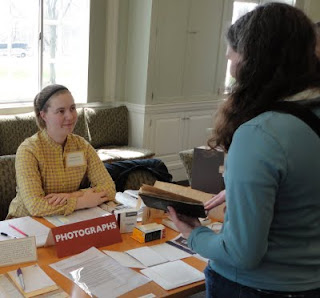
Elizabeth Rideout answers questionsAnother National Preservation Week has come and gone! I hope you had an opportunity to benefit from our tips or attended the “Protect Your Treasures” event. If you missed it we had a great turnout: questions were answered, examples were shown, and many, many conservation supply catalogs were handed out.


We had experts to answer questions about photographs, digital objects, textiles, and books & paper. This photo shows a few of the items on display at the Books & Paper table. Notice the “Collections Care” catalog published by Gaylord. They very generously sent two-dozen copies along with their supply catalog; thanks also to University Products for their catalogs.

Special thanks goes to Helen Bailey, Stephanie Wolff, Deborah Howe, Beth Hetland, Elizabeth Rideout, and Margaret Spicer for making “Protect Your Treasures” a success.

The next Preservation Week is April 22-29, so mark your calendar!

Written by Barb Sagraves

Friday, April 29, 2011

Preservation Tip of the Day #5

Each day this week to celebrate Preservation Week 2011, we'll be posting a handy tip to preserving your own collections. Stay tuned, and check back tomorrow!

Mold: Beware!

Mold can cause irreparable damage to all types of family heirlooms, precious books, and documents and it is an indication that your storage environment is unsound. Conditions that are too humid and warm can trigger a mold “bloom”. To keep items safe they need to be kept in a location that is dry and cool with air circulation: out of damp basements or garages, where the potential for water damage is elevated.

If you do find mold on your documents and you do not want to part with the item, seal it into a heavy plastic bag, place the bag in a freezer away from foodstuffs, and immediately contact a conservator. After handling any moldy object wash your hands. For more information:
http://www.nedcc.org/resources/leaflets/3Emergency_Management/08SalvageMoldyBooks.php