Showing posts with label book arts. Show all posts

Tuesday, March 24, 2015

Smith & Wolff at the New Hampshire Institute of Art exhibit

Sarah Smith, Book Arts Special Instructor, and Stephanie Wolff, Assistant Conservator, both have work on display at the New Hampshire Institute of Art exhibit: Artists' Books: From A to Zine.

The exhibit runs until April 29, 2015 and is located in the Amherst Street Gallery of the Institute in Manchester, NH.

Tuesday, December 23, 2014

Merry Christmas and Happy New Year!

Preservation Services, the Digital Production Unit, and the Book Arts Workshop will be closed from December 23 until January 5. 

For your pleasure we offer links to our most popular blog posts in 2014:


Tuesday, November 25, 2014

Road Trip to Geographies: New England Book Work, the New England Chapter of The Guild of Book Workers 2014-2015 Exhibition

On October 8th, 2014, Stephanie Wolff and I were invited to the University of Vermont to give a talk about the Geographies: New England Book Work exhibit and to share our techniques and approaches to our own work. The event was coordinated with the recent meeting of the Book Arts Guild of Vermont at their annual meeting to view special collections material. Prudence Doherty, Public Services Librarian, was our host and very generously brought out many items from the Library’s collection which also related to the theme of New England.

Upon our arrival the exhibit space was nicely occupied by students, hopefully some of them had taken the time to consider some of the items in the cases!


Here is a 180 of the three cases displaying the work. It’s not often that exhibitors get to see what the shows look like as a whole and this one was especially well displayed, thanks to Stephanie Wolff and Linda Lembke.


The first part of the program Stephanie and I talked about the show and highlighted the various techniques and expressions of creativity that were reflected in the bindings. 


Prudence, opened up the cases so we were able to really show the books in more detail, taking turns to point out the special features of many of the bindings. The show displays a wonderful array of fine bindings as opposed to artist’s books so we had an exploratory dialogue on the nuances between those two factions of binding approaches. 


After our time at the exhibit we retreated downstairs to Special Collections where Stephanie and I talked about our work. I come from a more traditional approach where I will always select a text and create a binding that reflects the contents. Stephanie on the other hand will take great pains and process to create the whole entity of her work. She brought to share all of her “story boards” that illustrated her voyage from concept to finished product. As a look into an artist’s creativity this was a wonderful opportunity to really see how these wonderful bindings come to be.

After our talk we stayed a bit to look at the wonderful items that had been placed on the table and had a pleasant visit with many of the members. I thank Prudence and the Book Arts Guild of Vermont for this opportunity to come together.

For more information about the exhibition, check out the Guild of Book Worker’s New England Chapter website.

The exhibit will be at the Bailey/Howe Library at the University of Vermont, Burlington, VT through December 12, 2014.


Written by Deborah Howe

Tuesday, August 19, 2014

Attachments: Book Arts Style

My last post discussed attachments with a conservation focus. Sometimes the creative possibilities are more important than the archival ones, or piercing holes in items is part of the artwork itself. In that case, here are some further ideas to attach loose items onto a page or in a book.

Just keep in mind that some of the methods below may create permanent changes in the mounted item and are not recommended for valuable, historic, or borrowed materials. Consider the long-term effects of any of these before using in your own projects.

As we saw in the last post (July 22) these were some options for attaching loose items to pages:

Paper clips:

Historically paper clips were made of metal, but those can be prone to rust over time in certain environmental conditions. Alternative shapes to the classic double loop include this dog and the circle. Those made from plastic or coated wire are also commonly available. The binder’s clip is useful for thicker materials. Both paper and binder’s clips come in a variety of sizes.


Eyelets:
 

This creates a hole in both the page and the item attached. It requires an eyelet setter such as this one often available where craft or sewing notions are sold.

Brads: 


Brads usually come in a brass colored metal, but are also available in mini sizes and in a variety of colors. Some even have a shaped head, such as a star or square, like this one.  Brads, like eyelets
and staples, create holes in both item and page.

Staples: These can be hard to remove without causing damage.

Adhesive: Paste and Glue

Adhesives are generally a permanent method of attachment, whether glues, double-sided tapes, or dry-mount adhesives.  Pastes (as opposed to glue) are generally reversible, however they often leave evidence of their application and use.

Pockets & Envelopes:

Loose pockets or envelopes can be attached by a variety of methods, like any loose item. They can also be incorporated into an album during its creation by sewing them in as part of a section or in binding of single sheets. Extensions (or guards) can be attached to the binding edge to allow for ease of use, like in this example where the purple extension is sewn in on the binding edge of the brown envelope. This album is bound with screw posts.

Slits and slots:


Photo corners:


Snaps:

 
These plastic snaps are a scrap-booking item, and operate much like a traditional sewn snap, but are attached more like a brad. A tiny hole is made in both item and page. The two parts of the snap are inserted through from front and back and “snap” together holding them in place.

Screw posts:


Screw posts are much like eyelets, as holes must be made in both item and page. They can hold thin to very thick items, and come in a variety of metals. These are usually used for binding, with extensions available to adapt the original to hold a collection of expanding material. But they can be used for putting a single item onto a page. These are often available at hardware and stationary stores.

Adhesive: Tape

All kinds of tape can work: traditional adhesive tapes such as medical paper adhesive tape, electrical, masking, double-sided, or cellophane. Newer products like colorful washi tape can also be used highlighting the attachment or construction while at the same time adding decoration. Just keep in mind that all tapes have adhesive that is extremely difficult if not impossible to remove.

Needle and Thread:


By machine or hand sewing a needle and thread can attach paper together not just cloth. Paper is not as forgiving of mistakes when sewing, but it works well for many things. I’d recommend testing the paper, needle size and type, and thread combination with the intended materials before embarking on a big project.

Buttons:


Attached with thread, buttons can also be used with a paper page to attach items. To help avoid tearing through the paper, sew a small piece of Tyvek behind the button to reinforce the attachment. Old shipping envelopes can be cut up for this purpose. The button can be used to help secure the thread attachment, sewing through the item and page, or it can be used with a buttonhole if the item can be cut into and has enough flexibility and strength to do so. Often flat buttons are most useful, especially if they will go into some kind of book or album. Stores that sell scrapbook supplies often have such flat, decorative buttons, and these are available at sewing stores as well.

Paper Frames:


Like pockets and envelopes, paper frames can be attached to a page as a means to hold a photo or bound in as pages when binding a new album. These frames can be folded to fit a photo and hold it in place without using adhesive.


This photo shows the reverse side of the frame above.


As I mentioned in my last post, with all these attachment methods remember to keep the spine and foredge of your book balanced with regard to the thickness of your added items. Doing so will help you avoid the foredge splaying out and the book not closing. When creating a new binding, stubs can be added at the spine to accommodate the addition of items over time.

I hope these suggestions prove helpful. I often collect small pieces of paper or ephemera, especially as reference for future projects. Sometimes I just toss these into a box, but perhaps I ought to create a “book of inspiration” using some of these attachment methods. Like commonplace books of the past, my book would be both personal and useful. What kinds of uses do you see for these attachments? What other attachment methods do you find helpful?

Written by Stephanie Wolff

Tuesday, April 1, 2014

Geographies: New England Book Work, the New England Chapter of The Guild of Book Workers 2014 – 2015 Exhibition

It’s exciting as book workers to apply our hand skills and creativity in projects outside of the regular work we do day-to-day. For some of us it means rebinding a book in a more decorative way than usual, for others it is using the entire book form as a means of artistic expression, both inside and out.

Three members of the Preservation Services staff, Deborah Howe, Sarah Smith, and Stephanie Wolff, exhibit new personal work in the New England Chapter of the Guild of Book Workers exhibition, Geographies: New England Book Work. The exhibition highlights members’ recent work whose content has a New England connection. It opened March 3rd at the Rhode Island School of Design’s Fleet Library. It then travels to The University of Southern Maine, University of Vermont, Williams College, Dartmouth College, and ends at the Creative Arts Workshop in New Haven, CT in the fall of 2015. Its Dartmouth College appearance is slated for April – August of 2015 in the Berry Library.


                                         Deborah Howe’s Reading the Forested Landscape

Deborah Howe bound a copy of Tom Wessels’ Reading the Forested Landscape. Deborah writes this about her book, “This is a rebinding of the text of Reading the Forested Landscape: A Natural History of New England by Tom Wessels and images by Brian Cohen. The materials chosen reminded me of the nature which the book is about. I had the wood veneer waiting to use it for the perfect project and this seemed like the one. The colors relate to the woods on a quiet slightly damp day.”

                          Sarah Smith’s A Map of New England, which Being… (book view)

Sarah Smith’s artist book A Map of New England, which Being in Some Places Defective, Shewing Particular Features from the Curious Woodcut Map of John Foster for William Hubbard in 1677: Presented by Percival & Byron and their Favorite Cartouches is a single sheet hand-drawn pen and ink map of New England, which can be read as a book or laid out flat for seeing the bigger picture of the region.

Sarah writes, “This book—currently a prototype intended for editioning—is inspired by the visual language of maps dating from before 1900. William Hubbard’s 1677 publication including “A Map of New England,” a woodcut carved and printed by John Foster was particularly inspiring. Some favorite features from the map are displayed in this book along with some cartouches (decorative “frames” which typically held a map’s title). Various historic maps and cherubs influenced the drawing of these cartouches. Percival and Byron assist in arraying the images on a map of New England and its modern boundaries.”

                       Sarah Smith’s A Map of New England, which Being… (flat open view)


                                                  Stephanie Wolff’s Sweet New England

Stephanie Wolff’s Sweet New England highlights a selection of confections that originated in the New England region, including the popular commercial treats Sugar Daddy, Necco Wafer, and Charleston Chew, and of course the classic New England sweet: maple sugar candy. Pages consist of hand-stenciled illustrations and letterpress printed text bound in a drum-leaf style, cloth case binding.

For more information about the exhibition, check out the Guild of Book Worker’s New England Chapter website.

Written by Stephanie Wolff

Tuesday, March 4, 2014

Goings on in The Book Arts Workshop!!

There have been a lot of things
going on recently in the Book Arts Workshop.


Artist Angela Lorenz visited the Book Arts
Workshop and presented her work to Esme
Thompson's Collage class.
In the fall, we went on an automnal letterpress excursion to two fabulous 
shops in Vermont-Heather Hale's and Kelly McMahon's. 
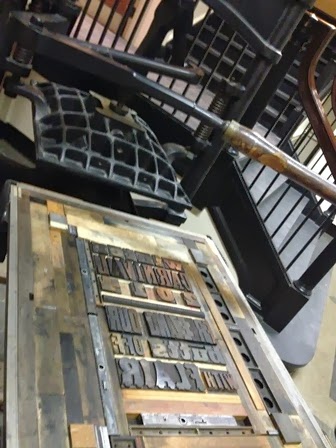
Heather showed us how her Heidelberg press works.

Kate Emlen's Drawing 1 Class came in to combine some
letterpress printing with their drawings.
This student is pretty happy with the poster she just made.
She was even happier with
 this version!
Lots of red in this holiday card.
Alex Halasz's History of the Book class has been working in the studios producing a group book with the theme of word play.

We had a holiday card-printing extravaganza that resulted in more happy printers!
Some amazing ornaments found in our shop.
Here is one of the student's type set for the Word Play book. Can you see the shape her type forms?
Two pages of the class book on the press ready to print.
Another page spread from the History of the Book Word Play class book.
A student quickly printing with our "new" Golding
Official Platen Press.
Posters from Hatch Show Print and Yee-Haw Industries on display for the Book Arts
Talk with Snacks about Sarah Smith's time at these two venerable letterpress
shops in Tennessee.
Kresge Physical Sciences Library hosted a
Geeky Valentine workshop in the
Book Arts Workshop.
Preparations for a Winter Carnival
poster-printing extravaganza.
The first proof pulled off the
Winter Carnival Poster on the
Washington Hand Press outside 
the Book Arts Workshop.


                                    A finished poster printed by a happy Carnivaler.


Written by Sarah M. Smith

Tuesday, November 5, 2013

In the Book Arts Workshop: Flat Sheet to Folio

Recently Book Arts Special Instructor Sarah Smith and I taught a two-day workshop in the Letterpress Studio, Flat Sheet to Folio creating a simple folded booklet using pressure printed imagery and letterpress printed text. Our project came from an exercise introduced to me by Steve Miller, professor of Book Arts at the University of Alabama, during a letterpress workshop at the Wells College Book Arts Summer Institute some years ago. Steve shared examples of this simple folded page and demonstrated its versatility in conveying a short piece of text with illustration. Many of the examples Steve shared used a linoleum block print. In our workshop we used the pressure printing technique.

We warmed up by creating an

origami envelope to hold the finished edition.

After discussing the way design and structure work together in this form, we began making our pressure prints. A pressure print uses a matrix under the printing paper that creates an impression when it comes in contact with an inked base plate held in the press bed.  We used a piece of type-high Plexiglas-topped MDF or plywood. A word of caution: check packing carefully prior to printing so not to damage the press.
                                
First we created the matrix from which to print the image.
                              
Then onto mixing ink color and printing.
                             
A finished matrix.
                             
Printing a pressure print. Placing the matrix under the printing paper and
                                          
Printing as usual.
                                                    
A finished print.
                     
                              By the end of the first day we each had a stack of twenty prints ready for text.
                              
The next day, Sarah presented a short lesson on setting type.
                                        
Imposition.
                                   
And then after mixing up a nice
 red-orange ink,
demonstrated the process of priniting text.


Once the Vandercook SP-20 was all set, I worked on the 
SP-15 with the students who wished to print with blue ink.

As students switched out their type, the required adjustments for each person’s folio became an opportunity to learn some of the nuances of imposition. With all the printing completed, we cleaned up and distributed type. 

Just before the end of the day we collated our sheets to complete the small edition. Each of us took away the sheets flat, which when dry, will become folios and fit into our envelopes. Lots of fun with image, text, and the press!

Written by Stephanie Wolff