Showing posts with label conferences. Show all posts

Tuesday, August 30, 2016

Interventions

I was lucky enough to be invited to the seminar titled Interventions led by Gary Frost at the University of Iowa Library, Conservator Emeritus at the University of Iowa Libraries, with assistance of John Fifield, University of Iowa School of Library and Information Science and the University of Iowa Center for the Book.  Our core group consisted of three graduate students from the SUNY- Buffalo conservation program, the conservator and assistant conservator from the library, a book conservator from the New York Historical Museum, a student from the Book Arts program, a volunteer who is a retired director of the Herbert Hoover Presidential Library and various others who came and went throughout the week.  The five types of Interventions are:

(1) Production
(2) Marketing and retailing
(3) Owners and users
(4) Library re-fabrication
(5) Book restorers and book conservators

More detailed information can be found here.  http://blog.lib.uiowa.edu/preservation/2015/02/10/book-intervention-types-a-construct-of-five-types/

The day started with presentations both from special guests and the participants themselves.  In the afternoon we moved to the back of the room where we were given many types of different books illustrating interventions and were asked to list what we saw and observed.  After we each had some time with the books we engaged in a lively conversation and shared our thoughts.  I came away with a new way of seeing and thinking about the book as an object and how my role as a conservator plays in the overall experience and life of this object.  I am delighted to have met so many wonderful new people and share in this unique experience.

View from the hill looking towards the Library and river.


Beautiful staircase inside the library.

Our seminar room.

One of our speakers with a chart comparing Codex versus Screen.
                 
Artist as owners.  A look at an erasure text.

Examining books for different types of interventions.

Beth Doyle gave a talk about mends done by amateurs or attempts to protect books
                  using a collection of school and common place books.              


Our group.


Written by Deborah Howe.

Tuesday, January 26, 2016

Dartmouth Library Hosts New England Code4Lib Regional Meeting


Early last December, library and technology enthusiasts from the far corners of New England gathered in the Jones Media Center here at Dartmouth College Library for the NE Code4Lib 2015 Fall Meeting.

Thanks to the awesome NDSR-Boston cohort, a lot of digital preservation ground was covered- including getting started with digital preservation, building a digital preservation community, and processing born-digital archival materials.
I gave a short talk about a script I use to QC and package digital materials for ingest into our repository.

You can see slides for these talks, and all of the great presentations from the meeting, on the NECode4lib 2015 Fall wiki page. Also, be sure to check out the Storify for the day put together by Joe Monibello.

The Book Arts Workshop also played a role in the event. My colleague Shaun Akhtar and I made use of the resources, expertise and equipment of the Book Arts Workshop to print custom letterpress give-away posters for the Meeting. It was a really fun way to tie together all of the technological expertise that resides here in the Library!

Written by Jenny Mullins

Tuesday, May 12, 2015

Howe at AIC

Deborah Howe, Collections Conservator, will be presenting at the AIC's 43rd Annual Meeting in Miami, FL, on May 14.  Deborah's talk, The Brut Chronicle: Revived and Reconstructed, will address the process of rebinding a medieval manuscript for twenty-first century use.

Tuesday, November 25, 2014

Road Trip to Geographies: New England Book Work, the New England Chapter of The Guild of Book Workers 2014-2015 Exhibition

On October 8th, 2014, Stephanie Wolff and I were invited to the University of Vermont to give a talk about the Geographies: New England Book Work exhibit and to share our techniques and approaches to our own work. The event was coordinated with the recent meeting of the Book Arts Guild of Vermont at their annual meeting to view special collections material. Prudence Doherty, Public Services Librarian, was our host and very generously brought out many items from the Library’s collection which also related to the theme of New England.

Upon our arrival the exhibit space was nicely occupied by students, hopefully some of them had taken the time to consider some of the items in the cases!


Here is a 180 of the three cases displaying the work. It’s not often that exhibitors get to see what the shows look like as a whole and this one was especially well displayed, thanks to Stephanie Wolff and Linda Lembke.


The first part of the program Stephanie and I talked about the show and highlighted the various techniques and expressions of creativity that were reflected in the bindings. 


Prudence, opened up the cases so we were able to really show the books in more detail, taking turns to point out the special features of many of the bindings. The show displays a wonderful array of fine bindings as opposed to artist’s books so we had an exploratory dialogue on the nuances between those two factions of binding approaches. 


After our time at the exhibit we retreated downstairs to Special Collections where Stephanie and I talked about our work. I come from a more traditional approach where I will always select a text and create a binding that reflects the contents. Stephanie on the other hand will take great pains and process to create the whole entity of her work. She brought to share all of her “story boards” that illustrated her voyage from concept to finished product. As a look into an artist’s creativity this was a wonderful opportunity to really see how these wonderful bindings come to be.

After our talk we stayed a bit to look at the wonderful items that had been placed on the table and had a pleasant visit with many of the members. I thank Prudence and the Book Arts Guild of Vermont for this opportunity to come together.

For more information about the exhibition, check out the Guild of Book Worker’s New England Chapter website.

The exhibit will be at the Bailey/Howe Library at the University of Vermont, Burlington, VT through December 12, 2014.


Written by Deborah Howe

Tuesday, October 14, 2014

Dartmouth at the Digital Directions 2014 Conference

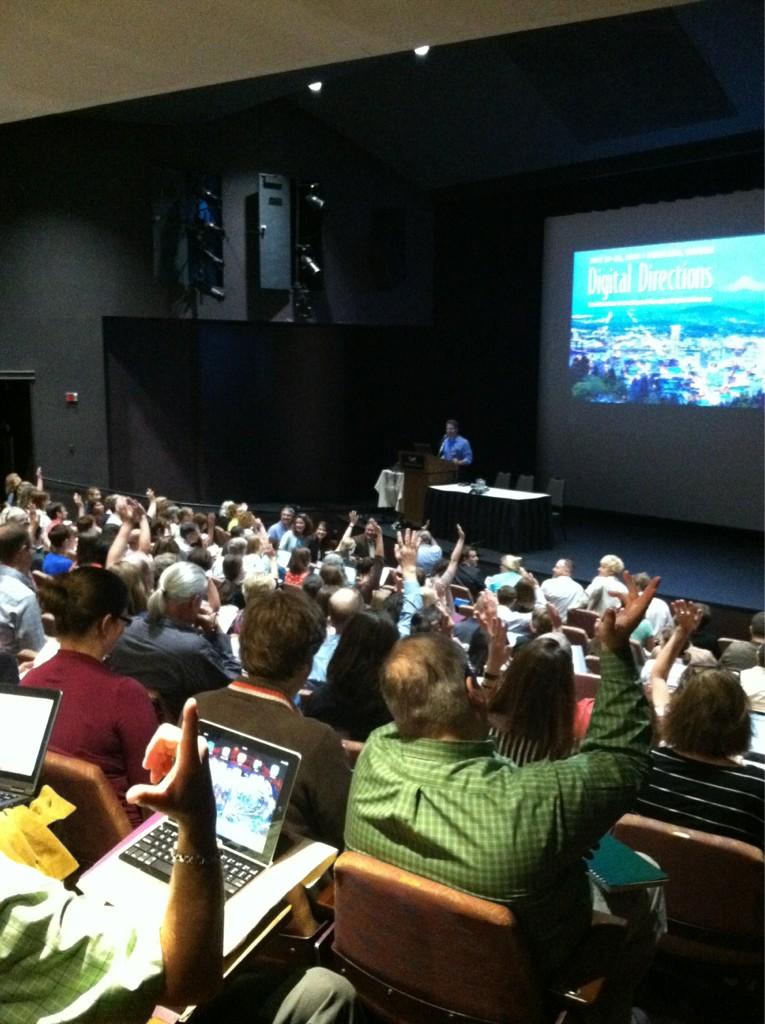
Image from the blog PDXretro.com

This past July I had the great opportunity to attend the Northeast Document Conservation Center’s Digital Directions 2014 conference. In a lucky turn, this year’s conference was held in Portland, Oregon, home of my alma mater, Reed College. In addition to reexperiencing the highlights of one of my favorite American cities, I was able to meet and engage with many people doing amazing work in digital collections across the country and beyond.


The conference covered a fascinating diversity of topics, from high-level project management and planning to specific examples of workflows and equipment setups. One of the first things impressed upon me was the fascinating diversity of digitization efforts occurring across the world. As the demand for digital content continues to expand, many institutions are rushing to fill that need. Because of this, it can often seem that no two institutions’ digital programs are the same, or even particularly similar.

To its credit, the Digital Directions did a phenomenal job accounting for these various setups. The three days were jam-packed with a fascinating variety of discussion topics and presentations. The first day consisted of mostly big-picture type talks. We discussed the interplay between digital preservation (maintenance of access to digital content) and digital curation (adding value to digital content), as well as how to craft each institution’s best practices and standards according to their needs. The day was wrapped up with an impressively no-nonsense discussion about rights and responsibilities from a legal perspective by Peter Hirtle, followed by a lovely meet-and-greet at the Portland Art Museum.

The following days covered a wide variety of topics, including a fascinating section about audio and video digitization (an area unfortunately outside my range of experience). However, it soon became apparent that the challenges faced by those audio and video digitization teams were remarkably similar to my own in the world of object and document reproduction. Many digitization projects face the same fundamental roadblocks: time, equipment, resources, access, and storage.
Image from NEDCC's twitter account

While the specifics varied, these fundamental issues could not help but make themselves apparent. The relative merits of, say, cloud storage (to pick a random example), can be endlessly debated among digital librarians, and indeed I’d doubt there ever will be a definitive final-word on this topic. But the crucial takeaway must be a willingness to engage with these issues, understanding the risks and drawbacks inherent in each option so that they can be minimized, or at the very least understood fully so that we may deal with them more effectively in the future. Among the many useful things I learned at Digital Directions 2014, perhaps the most important one was that my own peers are an incredible resource, both within Dartmouth and world-wide. By learning through their experiences and sharing my own, I hope to do my part to keep the Dartmouth Library’s Digital Collection growing and improving well into the future.

Written by Ryland Ianelli

Tuesday, November 29, 2011

Association of Moving Image Archivists Conference

The Association of Moving Image Archivists is the professional organization for those who are involved with preserving and making accessible film and video. I attended the recent conference in Austin, TX and came away with a couple of good tools:

Hannah Frost from Stanford University presented this new tool, the AV Artifact Atlas, for understanding video and audio technical issues. The goal is to create a reference work with examples so that non-technical folks will be able to identify what is wrong with their video, learn the cause of the problem, and confirm if there is anything that can be done to correct it.

The tool is actually a wiki and will eventually be open for additions from the audio-visual community. As someone who is coming to film and video preservation without a technical background this is a fantastic guide to help me talk to media experts. For instance, I’d never heard of “quilting” other than as a hobby but now I know how to recognize it and sadly, that it can’t be corrected.

The National Archives has made public their guidelines for reformatting materials and the context for the digitized items that they produce. I’ll be looking at these documents with a goal of updating Dartmouth Library’s digitization specifications and to develop a media preservation guide. This will also build on the ideas Helen picked up at DLF, detailed in the session notes from Strategies for Film and Video Digitization.

Finally, clips from “The Orozco Mural Quetzalcoatl” were shown both at the Reel Thing technical session and Archival Screening Night. Russ Suniewick of Colorlab showed some before and after footage to demonstrate how they were able to restore the film to its original color after it had experienced magenta dye-fade; I showed a four-minute clip at Archival Screening Night as a teaser for the Spring 2012 world premier. Watch this blog for that announcement.

Written by Barb Sagraves

Tuesday, November 15, 2011

Digital Library Federation Fall Forum 2011

I had the honor of attending this year’s Digital Library Federation Fall Forum a few weeks ago as a Forum Fellow and I wanted to share a little of my experience on the blog.

First of all, I am so grateful to the DLF for giving me the opportunity to attend. There were three fellows this year and each of us was paired with a mentor for the conference, which was fantastic. My mentor introduced me to a bunch of people and gave me some excellent advice about career planning and working in the field. It was also great to meet the other fellows and learn more about their experiences and paths into digital librarianship.

In addition to all the professional socializing inherently involved in conference attendance, I attended several really great presentations and workshops, but for the sake of brevity I’ll just highlight a few:

UDFR: A Semantic Registry for Format Representation Information
This brief but informative session gave an update on the development of UDFR, the Unified Digital Format Registry. This registry will combine the existing PRONOM and GDFR registries to give a comprehensive, interactive listing of file formats, along with their significant properties and preservation risks. I can’t wait to see the result, which should go live in early 2012.

Digital Preservation Cloud Services for Libraries and Archives
This session outlined some of the ways in which cloud services could be a solution for ongoing digital preservation needs among library and archive institutions. Cloud-based services can answer some common technological needs, including:

  • Scalability – cloud services allow for quick resource provisioning and are generally pay-as-you go.
  • Cost-efficient maintenance – cloud services can maximize resource use thanks to economy of scale.
  • Configurability – levels of service can be defined according to institutional policies and need.
However, there are still issues relating to cloud services, particularly in terms of reliability and security. I actually heard someone in a different session mention that they had lost data during transfer to and from a cloud storage provider, so…keep that in mind if you’re considering cloud storage as a primary preservation solution. (Also keep in mind that this was just one person at one institution. Many other cloud service users may have had excellent experiences. Please share if you know of research in this area!)

Strategies for Film and Video Digitization
This 3-hour working session covered so much information that I have pages and pages of notes, so I’ll just mention the topics that were discussed:

  • Media preservation plans – their importance, and an example from Indiana University
  • File formats and digitization specifications
  • Digitization as a preservation strategy - this was really interesting, with examples of current practice from Northwestern, Indiana, and Stanford Universities
  • Storage methods
  • Workflow issues
A Google Doc with detailed notes from this session can be viewed here if you’d like to see more detail.

I also attended the post-forum Project Managers Meeting, in which I learned a lot about project management practices. In addition to some excellent discussion, the highlight of this meeting for me was Tito Sierra’s presentation on the Project One-Pager. His slides from that presentation can be found here, and I highly recommend looking them over if you’re interested in project management.

All in all, the forum was fun and informative, and I’m really glad I was able to attend. Thanks, DLF!

Written by Helen Bailey

Monday, October 31, 2011

Helen Bailey: 2011 DLF Fall Forum Fellowship Winner

I am very pleased to announce that Helen Bailey, Preservation Specialist, was selected to be a 2011 Digital Library Federation Forum Fellow for the upcoming Fall Forum. The DLF, a program of the Council on Library and Information Resources (CLIR), is a network of libraries and related agencies pioneering innovative uses of information technologies and community expertise to extend collections and services.

Helen was one of three fellows selected from an international application process and will receive complimentary hotel, travel, board, and registration (up to $1,000) for the 2011 DLF Fall Forum in Baltimore, MD. The Fellowships are awarded to a librarian or LIS student new to the profession, based on strength of application essay, nomination, and resume. This is our second success in this prestigious fellowship program: Mina Rakhra was also a DLF Forum Fellow in Fall 2004.

Helen first joined the Library as an intern in Preservation Services, while finishing her MSIS degree (2009-10), a year later she was the successful applicant for the Preservation Specialist. She has been an active member of a number of Library teams working on digital library issues, most notably the Library's Digital Projects and Infrastructure Group (DPIG), which has just completed a digital program plan, including our first digital preservation policy, to guide our digitization efforts moving ahead.

To read more about Helen and the other 2011 Fall Forum Fellows go to: http://www.diglib.org/archives/2372/

Written by Barb Sagraves

Tuesday, August 9, 2011

Learning New Things-- The 2011 Digital Preservation Management Workshop

I recently attended the ICPSR Digital Preservation Management workshop, held in June at SUNY Albany. This amazing course is a jam-packed five-day program on the intricacies of developing and managing a digital preservation program within a library or archive setting. No small task, but the amazing instructional team led by Nancy McGovern and Kari Smith was certainly up to the challenge.

The workshop actually started several weeks prior to the first day, with some pre-requisite “homework” to build a good foundation in core digital preservation concepts. If you’re seriously interested in digital preservation and you haven’t read these documents, do so immediately! Yes, some of them are very long and detailed, but this is important stuff and it’s well worth the time.

I had already read these documents, some of them in great detail with a highlighter, and some of them with just a quick skim, so this was a nice refresher on some of the concepts we need to focus on as we build our digital preservation infrastructure.

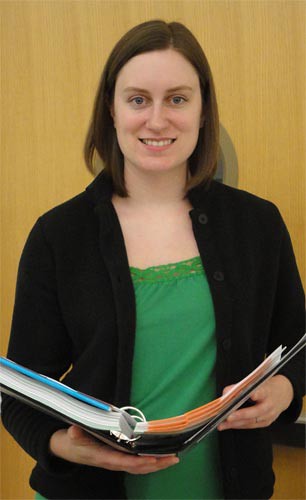
I got so much out of this workshop that it’s hard to pare down my notes (see picture below of the giant binder-o-information we received on day one).

But if I had to sum it up in a sentence, I’d say the most useful outcome (other than meeting a bunch of really great digital archivists and librarians) was that I now have enough information to formulate a plan. We’ve been talking for a while about what we need to have to support digital preservation; now we know how to get there.

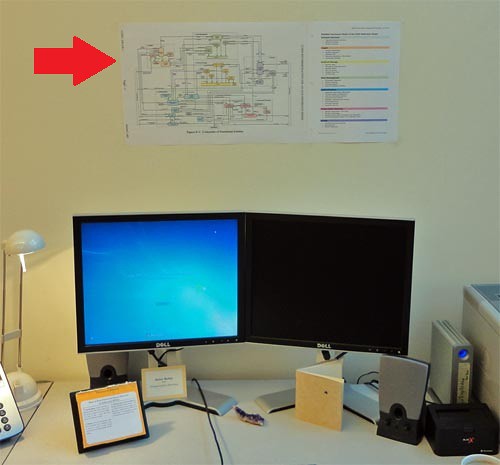
And, in addition to the awesome binder-o-information, I now have a full-color composite model of the OAIS Functional Entities that lives on the wall above my desk.

Nerdy, yes, but I love that I can look at it every day and see the ultimate goal right in front of me.

Written by Helen Bailey

Tuesday, July 19, 2011

DigCCurr Professional Institute

EAT MOR CHIKIN
DigCCurr* Professional Institute is an IMLS funded program of the School of Information Science at the University of North Carolina at Chapel Hill. For the past three years Professors Helen Tibbo and Cal Lee, along with other internationally recognized experts, have hosted a one week professional development class on the theory and practice of digitial curation for the digital object lifecycle.

I was a student in the May 2011 session and it was an amazing week!

There were about thirty of us representing a broad range of organizations (university, government, and business archives; academic libraries; museums; historical societies) and a wide range of responsibilities (digital managers, catalogers, archivists, preservation librarians, directors, access services librarians). Each day was filled with lectures, hands-on labs, and discussion.

    Some highlights:
  • Manfred Thaller gave an overview of the PLANETS software and a tool to stimulate digital aging. It was a lot of fun to see how far you could corrupt a file and still get a usable document -- and at the same time discover file formats that need very little change to be un-openable.
  • Nancy McGovern spoke about OAIS and the need for digital curation program development.
  • Seamus Ross walked us through the DRAMBORA audit tool.

At the end of the week we were assigned to develop a project based on what we had learned at DigCCurr and implement the project during the next six months. Come January 2012 we will meet again in Chapel Hill to report on our projects, celebrate our successes, and console one another on imperfect implementations.

My project is to use the DRAMBORA tool for a risk assessment of our digital preservation policy. I'll post my experiences with the tool as the work moves forward.

Two other items related to DigCCurr:

-One of the program goals is to develop a community of digital currators. To that end Professors Tibbo and Lee have developed the Digital Curation Exchange. The DCE is a web based community open to anyone interested in digital curation; DigCCurr uses it as a home base for students to share information, however, anyone may join. If you haven't visited the site take a few minutes and look it over.

-Our class attended a Durham Bulls Baseball game and I discovered a new fried food: potato chips on a stick.

*Pronounced dij-seeker

Written by Barb Sagraves

Tuesday, March 8, 2011

Digital Curation Conference

Last December I had the opportunity to attend the 6th International Digital Curation Conference in Chicago, IL. The conference was a super fantastic two day event. Reviewing my notes there were lots of excellent presentations -- a few that stood out were:

Robin Rice (presenter) - "Research Data Management Initiatives at the University of Edinburgh". Robin mentioned the concepts of high and low curation:

  • High curation would be labor intensive and require human intervention (metadata creation would be a good example).
  • Low curation would be automated (for example checksums or file format validation).
As Dartmouth College Library moves forward with digital preservation these terms and concepts will be helpful in our conversations.

Catherine Ward (presenter) - "Making Sense: Talking Data Management with Researchers". The "Incremental" project was designed to improve research data management within the institution by focusing on providing better advice, training, and support for researchers. It's a very common sense approach and worth referring to as the College designs a program to support data management.

I also participated in a pre-conference, Digital Curation 101 Lite. It was led by Sarah Jones, Martin Donnelly, and Joy Davidson and used the Digital Curation Centre lifecycle model as the basis for the course. It included lots of good advice about knowing your audience and being mindful of language that might scare them off (i.e. data curation).

These notes just scratch the surface of the conference. If you are interested in minding your data and want to learn more about digital curation, follow any of the links in this post. Mark your calendar, the next conference will be held in Bristol, England in December 2011.

Written by Barb Sagraves