Showing posts with label commercial binding. Show all posts

Tuesday, May 29, 2012

Introducing the String Binding

Along with processing serial titles for commercial binding, I’ve been working on some in-house treatments for magazines and small pamphlets. Usually, serial titles are sent out to a commercial binder to be bound in hard covers. Occasionally however an in-house treatment is more appropriate. For example, the string binding, adapted by conservator Deborah Howe, is ideal for undersized or short-run serials that are printed as single section issues.


This aspect in particular, whether stapled or pamphlet sewn, is what makes the string binding an easy and fast way to bind multiple issues into a single volume.

The string binding is made of a 20 point board that wraps around the issues, covering the front, spine, and back.

Each issue is secured into the cover with a thick linen thread wrapped tightly around the spine section of the cover and through the center of the magazine.

A separate piece of thread can be used for each issue or a continuous thread can be wrapped through each issue one at a time which saves time in tying knots.

Once all the issues are attached into the 20 point cover a protective piece of book cloth is glued over the spine and strings.

This adds support to the spine and front and back hinges. For volumes that are tall, heavy, or floppy it is best to reinforce the covers with a 40 point board on the inside of each cover.

Written by Elizabeth Rideout.

Tuesday, December 20, 2011

Binding the Collected Works of Liszt, Part 2

Reporting from the commercial binding desk, it’s time to follow up on the progress of the Collected Works of Liszt project. Last I reported, I had sent out twenty-nine music scores for rebinding from the Collected Works of Liszt. Some volumes were in worse condition than others but all were considerably dirty and at risk of pages yellowing and becoming brittle. Some volumes had torn or loose pages and others had broken bindings.

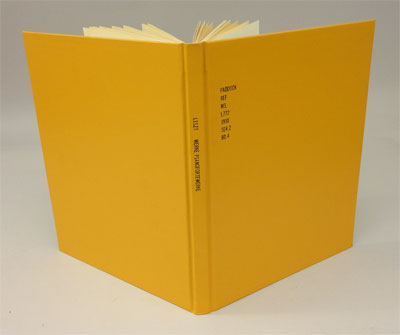
All twenty nine Liszt scores were delivered back to Preservation Services right on schedule. I checked them in right away to confirm there weren’t any missing volumes. The Liszt scores were rebound in yellow book cloth (chosen by the staff at Paddock Music Library) and with flat spines to allow for the fullest opening when being used. Finally I attached a barcode sticker to each volume. Barcode stickers correspond to electronic item records in the library database which allows for fast and easy search and tracking of each volume.

At this point the Liszt scores are ready for stage two, mass deacidification. Because I am working with so many volumes at once, they will be shipped out as a group to a vendor, Preservation Technologies. Deacidification is a process that utilizes chemistry to neutralize the pH of book and paper materials to prevent or slow deterioration caused by acidity.

With page repairs, rebinding, and barcoding already complete it was simple to prepare the Liszt scores for this process. I packed the volumes into crates, following instructions provided by the vendor to pack books spine down. I included a packing slip listing each volume, corresponding barcode, total number of volumes, and total number of crates. From this point it won’t be long until they are back on the shelf. Upon return from mass deacidification I’ll give one final check and send them along to Paddock Music Library.

Written by Elizabeth Rideout

Tuesday, September 27, 2011

Binding the Collected Works of Liszt

It’s been over six months since I joined the team here in Preservation last January and about time I shared some news from the commercial binding desk. On a continual basis serial titles (journals, magazines, and music scores) make their way to my desk to be processed and sent out for binding at Acme Bookbinding in Charlestown, MA. This is an ongoing task because the library is always acquiring new issues of print periodicals. It’s fun to have such a wide variety of material pass through my hands from popular music and art magazines to academic journals in psychology, law, geography, and more.

In addition to the standard flow of serials going out for binding, I’ve been working on a special binding project for Paddock Music Library. It may not be obvious but in terms of preservation, music scores get hit hard by repeated use and often need rebinding. The most recent example of this is Paddock’s set of Franz Liszt’s collected works, which was identified as being in especially poor physical condition. Because of its age, the bindings are falling apart and paper is becoming brittle causing loose and easily torn pages.

Liszt - Spine Damage

Once all the volumes of Liszt’s works arrived in Preservation, the process for rebinding began. I checked each volume in and examined it for page tears and other damage to make note of. I actually discovered there was a missing page in one book and in another a whole section was upside-down. With a complete list of repairs, I headed to the bench with heat-set tissue (the conservator’s iron on patch) and tacking iron in hand. The paper repairs went smoothly and I was on to the next step, entering each volume into the Acme bindery database. For a set like this every volume has a unique title and in this case the title is in German. I entered all the spine information for each book including composer, title, call number, and special instruction (‘upside-down pages to be righted’ for example), and printed a binding slip to be tucked inside the cover.

Liszt - Overall Damage

All twenty-nine volumes, now ready for rebinding, were checked one last time and then packed for shipment. They won’t be gone for long though. In a short two weeks I’ll be unpacking them and prepping the set for part two, deacidification. Stay tuned!

Written by Elizabeth Rideout